Fall brain-map appointments are open — book your free consult →

Executives & leadership teams

Lead with a brain that’s trained for it.

For founders, executives, surgeons, pilots, traders — anyone whose day is decided by how their brain holds up under load. A qEEG brain map shows where focus, recovery and sleep are breaking down. Neurofeedback at home trains them, 20 to 30 minutes at a time, wherever you are that week.

A confident professional in a dark blazer stands with arms folded in a modern office

Sound familiar?

The job didn’t get harder. Your margin got thinner.

High performers rarely lack discipline. What runs out is the brain’s capacity to hold focus, recover and switch off — and that capacity is trainable.

Decision fatigue by mid-afternoon

The morning is sharp. By three o’clock every call feels heavier than it should.

Focus that frays in long meetings

Re-reading the same line, losing the thread, reaching for the phone.

A mind that won’t shut off at 2 a.m.

Tomorrow’s agenda running on a loop while the body is exhausted.

A shorter fuse with the people you lead

Reactions arriving before judgment does — and the repair work afterwards.

Recovery that takes the whole weekend

A nervous system that can’t come down from Friday before Monday starts.

Words slower than the thinking

Presentations and negotiations where the idea is there and the delivery lags.

A different approach

From productivity hacks to a measured baseline.

Most of what’s sold to executives works on the schedule, the habits or the mindset. None of it looks at the brain doing the work.

The standard approach

  • Executive coaching with no objective data
  • Productivity systems that add structure but not capacity
  • Caffeine to start the day and something else to end it
  • Meditation and mindfulness apps that never quite stick

The Kerov™ executive approach

  • An objective qEEG map of how your brain performs under load
  • Protocols chosen from your own data, not a generic “peak performance” template
  • 20–30 minute sessions at home or on the road, with a weekly clinical check-in
  • A second map at the end, so the change is measured

What we measure

Your baseline, on paper.

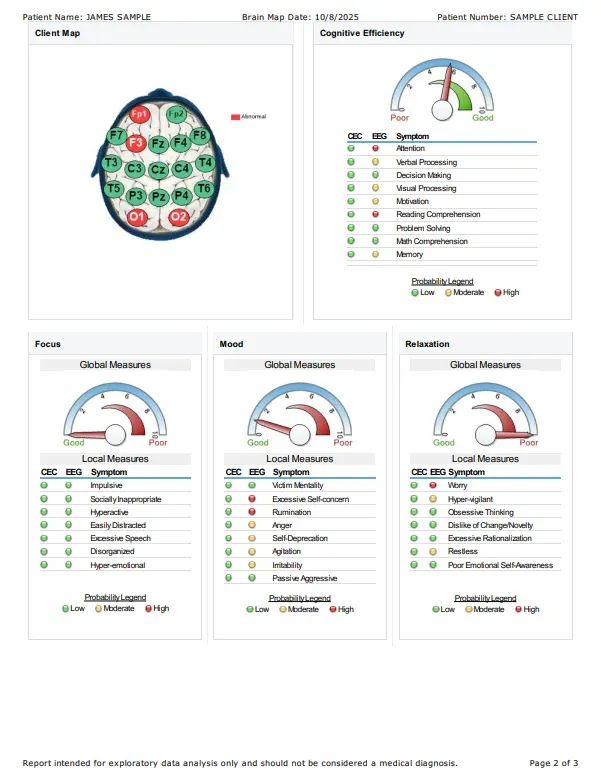
The map records your brain’s electrical activity for under ten minutes, eyes closed and eyes open, and compares it with a database of brains your age. The report turns that into four things a leader actually cares about.

  • Cognitive efficiencyHow much effort your brain spends to hold focus — and whether it’s spending it in the right places.
  • Focus under loadWhether attention holds when the task gets long, or scatters into fast, anxious activity.
  • Arousal and recoveryHow quickly your nervous system shifts from alert to rest. Slow recovery is where burnout starts.
  • Sleep readinessThe rhythms that have to settle for sleep to come, and whether they can.
Sample qEEG brain map report page showing a head map and gauges for cognitive efficiency, focus, mood and relaxation
A page from a sample brain-map report: focus, mood and relaxation, measured — not guessed.

The evidence

What the studies in healthy adults report.

Neurofeedback in healthy adults has its own literature, separate from the clinical trials. A three-part 2013–2014 review catalogued controlled studies reporting gains in sustained and executive attention, memory, reaction time, complex psychomotor skill, mood and well-being. Meta-analyses since then report a medium effect on working and episodic memory from theta training, a small effect on episodic memory against active controls, a small overall effect on attention that did not hold in the sham-controlled subset, and a large effect on motor performance. In athletes, sensorimotor-rhythm training sharpened the attentional state that precedes skilled action — the “quiet mind before the shot” that performers describe.

Neuroscience & Biobehavioral Reviews · 2014

Review of controlled studies in healthy and older adults

Reported outcome gains across studies in sustained, orienting and executive attention, memory, spatial rotation, reaction time, complex psychomotor skills, intelligence measures, mood and well-being; 23 controlled studies reported neurofeedback learning indices alongside the gains.

Read the paper ↗

Psychophysiology · 2021

Systematic review

Found promising evidence for neurofeedback’s effect on executive functions in healthy adults and identified the frequency targets most often linked to gains, while noting the number of well-designed studies is still limited.

Read the paper ↗

International Journal of Environmental Research and Public Health · 2022

Meta-analysis of 11 studies

Theta neurofeedback improved working memory (Hedges’ g = 0.56) and episodic memory (g = 0.62) in healthy participants; the authors describe it as useful adjunct training.

Read the paper ↗

NeuroImage · 2023

16 randomized trials, 374 participants

A significant, large effect of neurofeedback on motor performance measured after the last training session (standardized mean difference 0.85).

Read the paper ↗

Neuroscience & Biobehavioral Reviews · 2023

Meta-analysis of 21 studies with active controls

A small, significant positive effect on episodic memory (g = 0.31), larger in participants who successfully learned to regulate their EEG; the review notes wide variation in protocols and many under-powered studies.

Read the paper ↗

Imaging Neuroscience · 2024

15 randomized trials, 569 participants

A small, significant overall effect on attentional performance (standardized mean difference 0.27); within the eight sham-controlled trials the pooled effect was not significant, and the authors call for more sham-controlled studies.

Read the paper ↗

All performance citations on our research page →

★★★★★

“It significantly helped me sustain my focus on the course. At this level your brain does wander and you need every competitive edge possible — I have clearly seen the benefits from just three weeks of Kerov.”

Michael Campbell · 2005 U.S. Open champion · Performance client

Corporate programs

We come to you.

A corporate program is built for the organization, not adapted from the individual one. It runs on your site, on your schedule, and only the parts your people need. Pricing on request.

  1. 01

    We map your people on site

    Our clinical team comes to your location to run the brain maps and evaluations. A quiet room and a chair are all we need. Each person receives their own Report of Findings.

  2. 02

    We prescribe only what the results call for

    We review the maps across the group and recommend which parts of the program your organization actually needs — training for some, sleep or stress work for others, nothing where nothing is needed.

  3. 03

    A Kerov technician, assigned to your company

    Where the need for neurofeedback is sufficient, we assign a technician to your organization who comes in and runs the sessions with your staff during the work week, under Adrian’s clinical supervision.

  4. 04

    Measured, then reported at the program level

    Every participant is re-mapped at the end. Your organization sees participation and overall outcomes. It never sees an individual’s data.

Ask about a corporate program Email hello@kerovhealth.com

What a brain map is like

One visit, or a cap shipped to your office. Under ten minutes of recording.

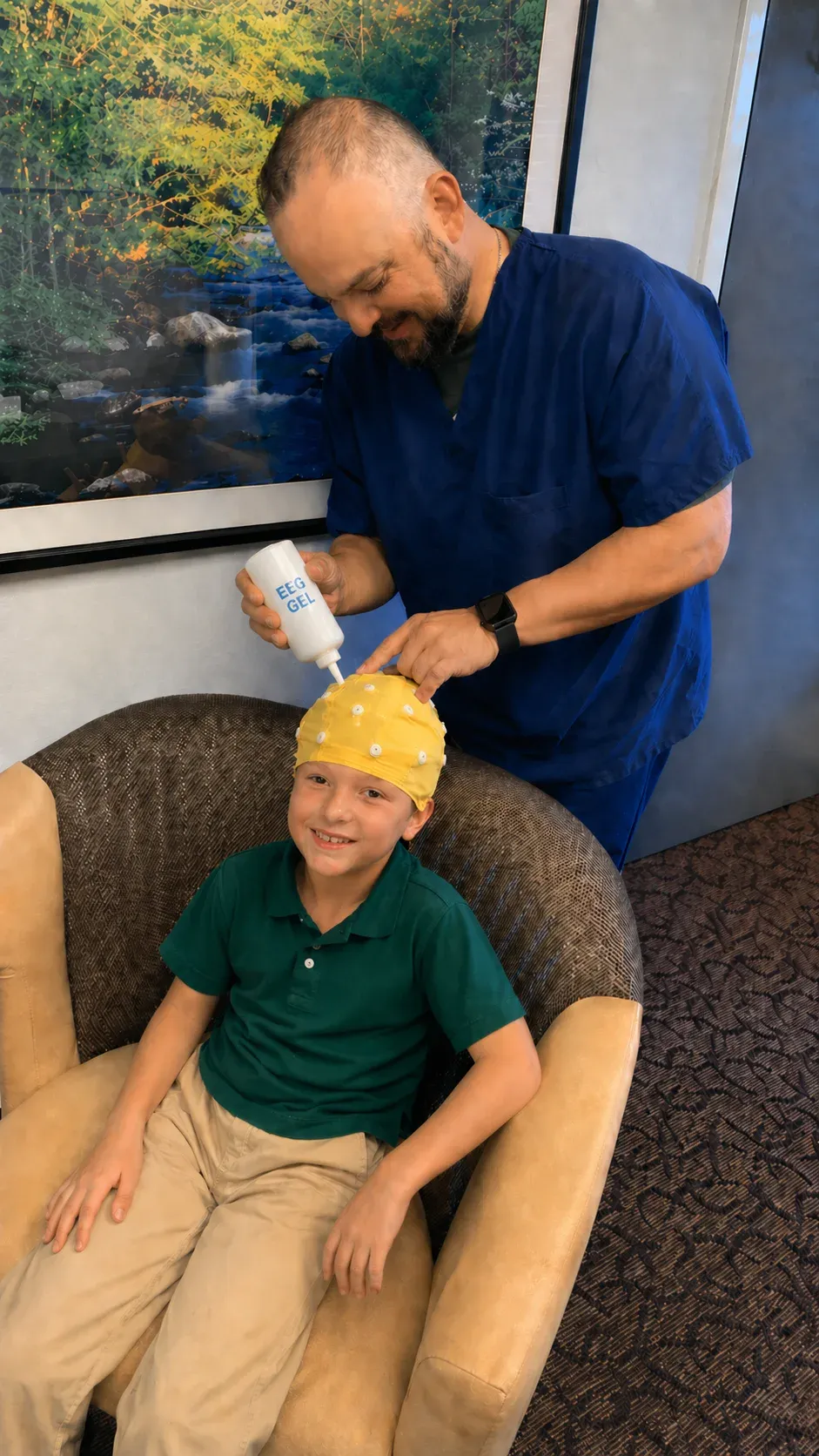
Here is the whole mapping visit. If Lake Mary is out of the way, we ship the mapping cap and run the recording remotely on a video call.

  1. 1

    A soft cap goes on

    It looks like a swim cap with 19 small sensors built in. We adjust it until it’s comfortable.

  2. 2

    A little gel at each sensor

    A conductive gel helps each sensor read clearly. No needles — the applicator has a blunt tip and only touches the cap.

  3. 3

    Two small ear clips

    Light clips on the earlobes give the recording a reference point.

  4. 4

    Sit quietly for a few minutes

    Eyes closed, then eyes open. Under 10 minutes of recording while your brainwaves appear live on screen.

Sample qEEG brain map report page showing a head map and gauges for cognitive efficiency, focus, mood and relaxation
A page from a sample report. Yours is built from your own recording.

What you take home

Your brain map, on paper — and explained in plain English.

At your Report of Findings we walk through every page together. Here’s what one of them shows.

  • The head map

    Nineteen sensor sites, each colored by whether your activity there sits in the typical range or outside it.

  • Cognitive efficiency

    A single gauge for how efficiently the brain is working, with the everyday skills it feeds: attention, memory, processing, problem-solving.

  • Focus, mood and relaxation

    Three gauges, each tied to real-world signs like distractibility, rumination or restlessness — so the numbers connect to what you actually see.

  • What it is not

    Not a diagnosis, and not an MRI. It’s a measurement of regulation that tells us where to train — and lets us measure change later.

Adrian Quevedo applies EEG gel to a smiling boy’s sensor cap during a brain map at Kerov Health

Clinical expertise

Performance science. Clinical precision.

Certified in qEEG and neurofeedback since 2002, Adrian uses objective brain data to identify exactly what’s holding your performance back — then builds training protocols that make peak state reproducible, not accidental. Performers on the field and in the boardroom deserve more than generic mental coaching. He leads every clinical program at Kerov™ Health.

28+
years in clinical practice
2002
certified in qEEG & neurofeedback

Adrian E. Quevedo, MS, NEI
Co-Founder & Clinical Director

The process

Four steps. One office visit, or none. Training wherever you are.

  1. 01

    Free consult

    30 min · Zoom or phone

    Tell us what’s going on. We’ll explain how the program works and whether it’s a fit — no pressure, no cost.

  2. 02

    Brain map (qEEG)

    ≈45 min · Lake Mary office

    A comfortable sensor cap records your brain’s electrical activity — in our office, or with a cap we ship to you. Painless, and under 10 minutes of recording.

  3. 03

    Report of Findings

    Virtual · video call

    We walk you through your map in plain English and lay out a personalized plan, timeline and cost.

  4. 04

    Train at home

    20–30 min · 5–7× a week

    Pick up your kit and train on your schedule while watching shows you like. We monitor progress and meet weekly on Zoom.

Good questions

Executive performance, answered.

I travel constantly. Can I still train?

Yes. The training kit fits in a carry-on, sessions take 20–30 minutes on a laptop or tablet, and the weekly check-in is a Zoom call. Most executives train early morning or before bed, wherever they are that week.

How much time does it take?

A free 30-minute consult, one brain-map visit (or a cap shipped to you), then five to seven short sessions a week at home during the Foundation Phase, plus a weekly check-in. Your Report of Findings sets the full plan and the re-map date before you commit.

How is this different from a mindfulness app or executive coaching?

Both work on habits and perspective. Neurofeedback works on the brain rhythms underneath them, with feedback hundreds of times a session and a before-and-after map that shows what changed. Many of our clients keep their coach; the coach usually notices first.

Is it confidential?

Your brain map and your results belong to you and are shared only with people you name. In a corporate program, the organization sees participation and overall program outcomes, never an individual’s data.

What is a qEEG brain map?

A brain map records your brain’s electrical activity using a soft cap with 19 sensors. The visit takes about 45 minutes and the recording itself is under 10. The result shows which areas are over- or under-active, so your training plan is built on data rather than guesswork. It’s painless and non-invasive — just come with clean, dry hair.

How soon will I notice changes?

Everyone responds differently. Many clients first report better sleep, often within the first 10 sessions, followed by improvements in focus and mood. We track your data weekly so progress isn’t a guessing game.

Do the results last?

Neurofeedback is a learning process, and like other learned skills the gains tend to hold. Life doesn’t stay still, though — a new job, a loss, a hard school year, an illness or a head injury can all shift things. That’s why many clients keep a maintenance option: a short tune-up when they need it, on their own schedule. It’s a choice, not a dependency.

Do I have to live near Lake Mary, Florida?

No. Central Florida families usually visit our Lake Mary office — 25 minutes from downtown Orlando — once, for the brain map and kit pickup; everything after that is remote. If the drive is a problem, or you live elsewhere in Florida or in another state, we ship a brain-mapping cap and training system to your door and run the map with you remotely, for a small additional cost.

What does it cost? Do you take insurance?

We don’t bill insurance. We accept HSA/FSA funds and offer financing through the Advance Care Card — interest-free for up to 15 months, with instant online decisions — so the program can be spread into monthly payments. You’ll see the complete cost at your Report of Findings, before you commit to anything. The first consult is free.How to apply →

Neurofeedback supports self-regulation and performance; it does not diagnose, treat or cure any condition, and individual results vary. Never change a medication without your prescribing doctor.

Your next step

Ready to see your baseline?

Book a free 30-minute consult by Zoom or phone. Tell us what your week looks like and what you’d like more of, and we’ll tell you what a map can show.

  • 30 minutes · Zoom or phone · no obligation
  • Talk with a clinician, not a salesperson
  • Leave with a clear picture of the process and cost

Prefer to talk now? (407) 708-3200

CallBook a Free Consult