ADHD
Your child’s ADHD brain is unique. Stop guessing. Start understanding.
The diagnosis is shared. The expression is not. We use qEEG brain mapping to discover why your child struggles — removing the blame and creating a clear, personalized plan they can train on at home.

A different approach
The shift from blame to curiosity.
You’ve tried everything. You’re exhausted. And you’ve probably asked yourself: “Why won’t my child just try harder?” The answer usually isn’t effort — it’s regulation.
The standard approach
- Checklists and subjective questionnaires
- Trial-and-error with medications
- Behavior plans aimed at suppressing symptoms
- Frustration, blame, and constant guessing
The Kerov™ approach
- Objective data from a qEEG brain map
- A clear picture of the regulation pattern behind the behavior
- Neurofeedback training tailored to that exact map
- Compassion, clarity, and a plan that fits your child
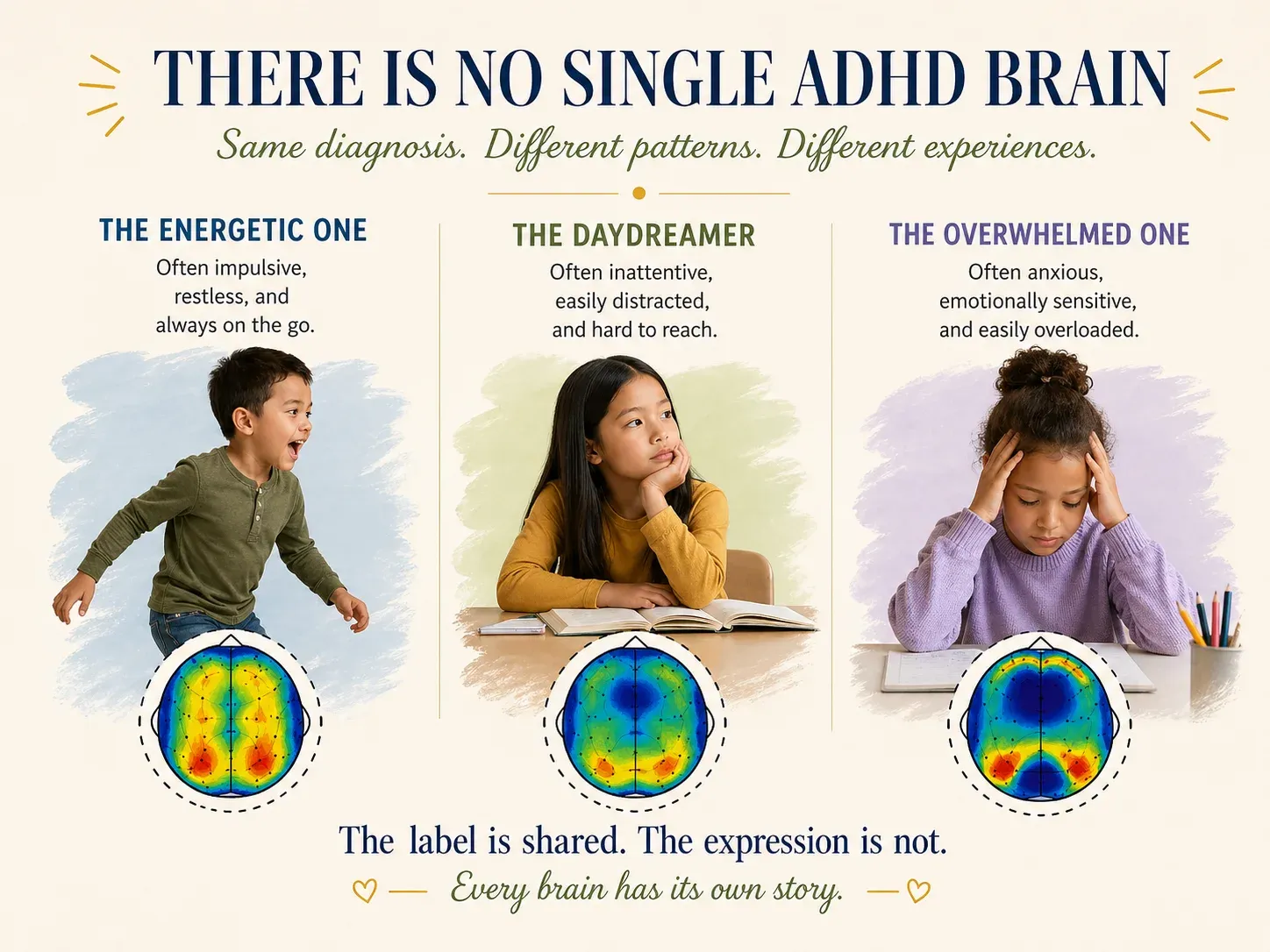
There is no single ADHD brain
Same diagnosis. Different patterns. Different plans.
Three children can share one diagnosis and have three different brains. A brain map shows which pattern you’re dealing with — so training targets the cause, not just the label.
- The energetic oneImpulsive, restless, always on the go. Often a brain running fast in the wrong places.
- The daydreamerInattentive, easily distracted, hard to reach. Often an under-aroused brain looking for stimulation.
- The overwhelmed oneAnxious, emotionally sensitive, easily overloaded. Often a brain that can’t filter the noise.
What a brain map is like
Not an MRI. Not a diagnosis. A clear picture of how the brain is regulating.
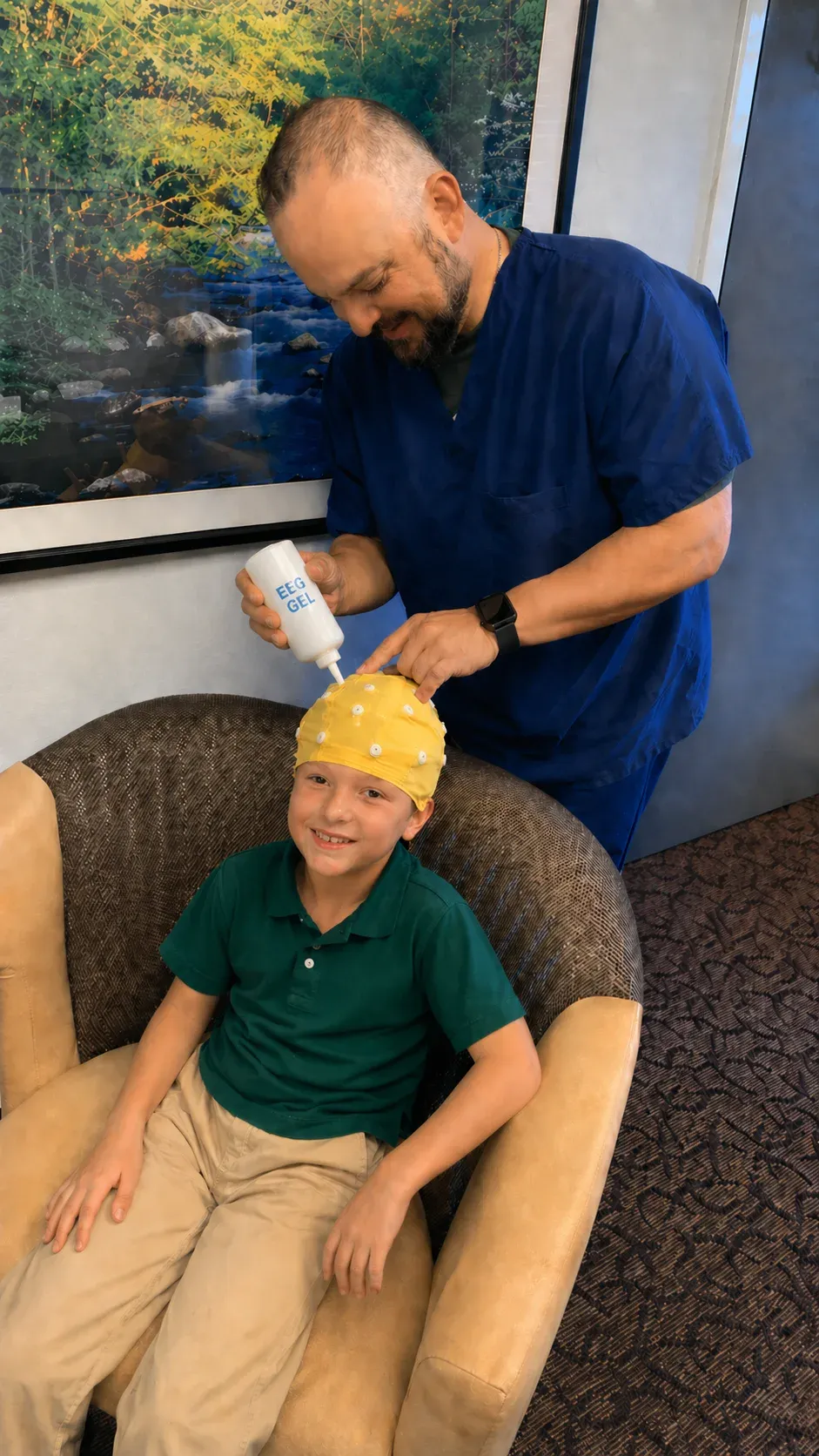
A qEEG brain map adds objective data to a conversation that has usually only had checklists. Here’s the whole visit — most kids think the cap is fun.
- 1
A soft cap goes on
It looks like a swim cap with 19 small sensors built in. We adjust it until it’s comfortable.
- 2
A little gel at each sensor
A conductive gel helps each sensor read clearly. No needles — the applicator has a blunt tip and only touches the cap.
- 3
Two small ear clips
Light clips on the earlobes give the recording a reference point.
- 4
Sit quietly for a few minutes
Eyes closed first, then eyes open — and if a younger child can’t keep their eyes closed, eyes open is all we need. Under 10 minutes of recording in total, while the brainwaves appear live on screen.
What you take home
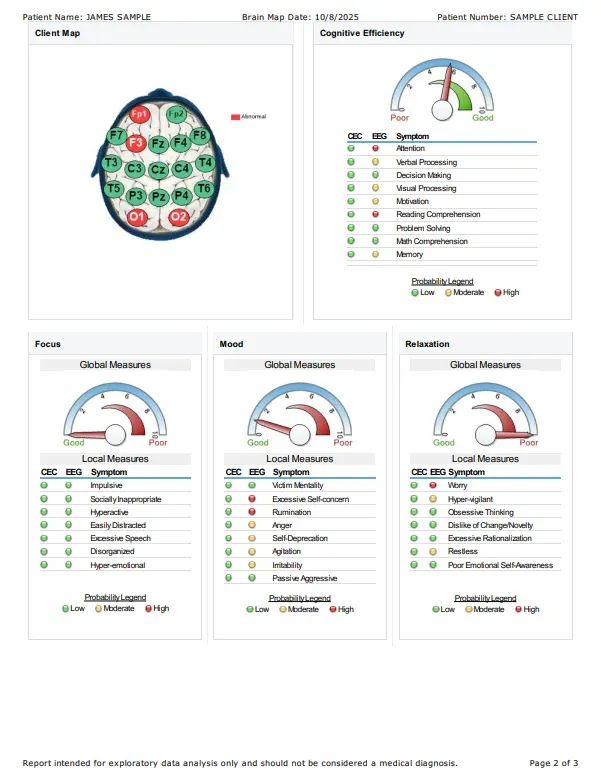
Your brain map, on paper — and explained in plain English.
At your Report of Findings we walk through every page together. Here’s what one of them shows.
The head map
Nineteen sensor sites, each colored by whether your child’s activity there sits in the typical range or outside it.
Cognitive efficiency
A single gauge for how efficiently the brain is working, with the everyday skills it feeds: attention, memory, processing, problem-solving.
Focus, mood and relaxation
Three gauges, each tied to real-world signs like distractibility, rumination or restlessness — so the numbers connect to what you actually see.
What it is not
Not a diagnosis, and not an MRI. It’s a measurement of regulation that tells us where to train — and lets us measure change later.
“My 8-year-old son, who is non-verbal with ASD/ADHD, has been through countless providers. Adrian and his team removed the guesswork by using real data to create a clear, personalized plan. We’ve already noticed improvements in his focus, emotional regulation, sleep and overall mood.”
Clinical expertise
28 years of clinical practice. A new level of clarity.
Certified in qEEG and neurofeedback since 2002, Adrian has spent more than 28 years designing personalized brain-training programs. He leads every clinical program at Kerov™ Health, and believes families deserve to feel heard and understood — not dismissed or blamed.
- 28+
- years in clinical practice
- 2002
- certified in qEEG & neurofeedback
Adrian E. Quevedo, MS, NEI
Co-Founder & Clinical Director
The process
Four steps. One office visit. Training at home.
- 01
Free consult
Tell us what’s going on. We’ll explain how the program works and whether it’s a fit — no pressure, no cost.
- 02
Brain map (qEEG)
A comfortable sensor cap records your brain’s electrical activity — in our office, or with a cap we ship to you. Painless, and under 10 minutes of recording.
- 03
Report of Findings
We walk you through your map in plain English and lay out a personalized plan, timeline and cost.
- 04
Train at home
Pick up your kit and train on your schedule while watching shows you like. We monitor progress and meet weekly on Zoom.
Parents ask
Questions about ADHD & neurofeedback.
What is a qEEG brain map?
A brain map records your brain’s electrical activity using a soft cap with 19 sensors. The visit takes about 45 minutes and the recording itself is under 10. The result shows which areas are over- or under-active, so your training plan is built on data rather than guesswork. It’s painless and non-invasive — just come with clean, dry hair.
Can neurofeedback really be done at home?
Yes. After your in-office brain map, all training happens at home with a clinic-grade kit we configure for you. We monitor your data remotely, adjust your protocols, and meet with you weekly on Zoom — so you get clinical supervision without the weekly commute.
How long is the program?
Every program starts with the Foundation Phase: five weeks of 5–7 short sessions per week. At week five we review your progress together. From there you can continue neurofeedback training, add functional lab testing and a supplement protocol, do both — or move to maintenance, keeping your system for tune-ups when life calls for one.
Is it safe for children?
Yes. Neurofeedback is non-invasive and drug-free, and we work with children as young as four. Sessions feel like watching a show. Some people feel a little tired after early sessions; this typically fades within the first couple of weeks.
Do I need to stop medication?
No — and never change or stop a medication without your prescribing doctor. Neurofeedback can be done alongside medication. If your needs change over time, that’s a conversation between you and your doctor.
What does it cost? Do you take insurance?
We don’t bill insurance. We accept HSA/FSA funds and offer financing through the Advance Care Card — interest-free for up to 15 months, with instant online decisions — so the program can be spread into monthly payments. You’ll see the complete cost at your Report of Findings, before you commit to anything. The first consult is free.How to apply →
Neurofeedback supports self-regulation; it does not diagnose, treat or cure ADHD, and works alongside your child’s medical care. Never change a medication without your prescribing doctor.
Your next step
Ready to find answers for your child?
Book a free 30-minute consult. We’ll listen, answer your questions, and tell you honestly whether our approach fits your family.
- 30 minutes · Zoom or phone · no obligation
- Talk with a clinician, not a salesperson
- Leave with a clear picture of the process and cost
Prefer to talk now? (407) 708-3200