
Anxiety, stress & PTSD
Anxiety isn’t who you are. It’s a pattern in a brain that won’t downshift.
For adults and children. We use qEEG brain mapping to see why your brain stays on high alert — then design neurofeedback that teaches it how to settle, naturally and without guesswork.

Sound familiar?
You can’t think your way out of an over-aroused nervous system.
Anxiety is a brain state, not a willpower problem — in adults and in kids.
Racing thoughts at 3 a.m.
A mind that won’t switch off when the body is exhausted.
The pre-school meltdown
Stomach aches, tears, or refusal before the day has started.
Chest tightness that won’t quit
A nervous system stuck on high alert with no obvious reason.
When “just relax” doesn’t work
Ten deep breaths don’t touch it, because the pattern is in the brain, not the willpower.
PTSD: still on alert
Veterans, first responders, ICU survivors, kids after trauma — a nervous system that never got the message the danger passed.
A different approach
From “just relax” to real regulation.
The standard approach
- Symptom checklists and self-report scales
- Trial-and-error with medications
- Coping skills aimed at managing — not changing — the underlying state
- Months of guessing while sleep, school and relationships suffer
The Kerov™ approach
- An objective qEEG map of your specific arousal pattern
- A clear answer to “why is my brain stuck in alert mode?”
- Neurofeedback that teaches your brain to downshift on its own
- Drug-free and non-invasive — for adults and children alike
Objective data
See the brain before you train it.
A brain map shows the electrical signature of an anxious brain — where it’s running too hot, where it can’t quiet down, and where regulation has broken down. No more guessing what kind of anxiety you or your child has.
Identify the arousal pattern
A brain stuck in fight-or-flight? An overactive worry loop? A nervous system that can’t move from alert to rest? The map shows exactly where to train.
Personalized neurofeedback
Using your map, we design at-home sessions that gently teach your nervous system to downshift — supporting sleep, calm and emotional steadiness over time.
Living with PTSD?
Trauma is one of the best-studied uses of neurofeedback.
Post-traumatic stress leaves a recognizable signature in the brain’s rhythms — an alarm system that stays switched on. Randomized controlled trials, including double-blind studies, have tested EEG neurofeedback for PTSD and reported meaningful symptom reduction, with remission rates around 60% in the neurofeedback groups. The trials are small and the researchers call for larger ones; we say the same.
We work with veterans, first responders, ICU survivors and children after trauma — alongside their therapists and doctors, never instead of them. Our non-profit, Kerov Org, funds trauma-focused neurofeedback research.
- A brain map shows where the alarm is stuck “on”
- Training happens at home, on your schedule — no waiting rooms
- Works alongside therapy, EMDR and medication
- Weekly check-ins with a clinician who has done this for 28 years
What a brain map is like
This is the whole visit. No needles, nothing to feel.
A qEEG brain map only listens to the brain’s natural electrical activity — nothing is sent in. Here’s exactly what happens in our Lake Mary office.
- 1
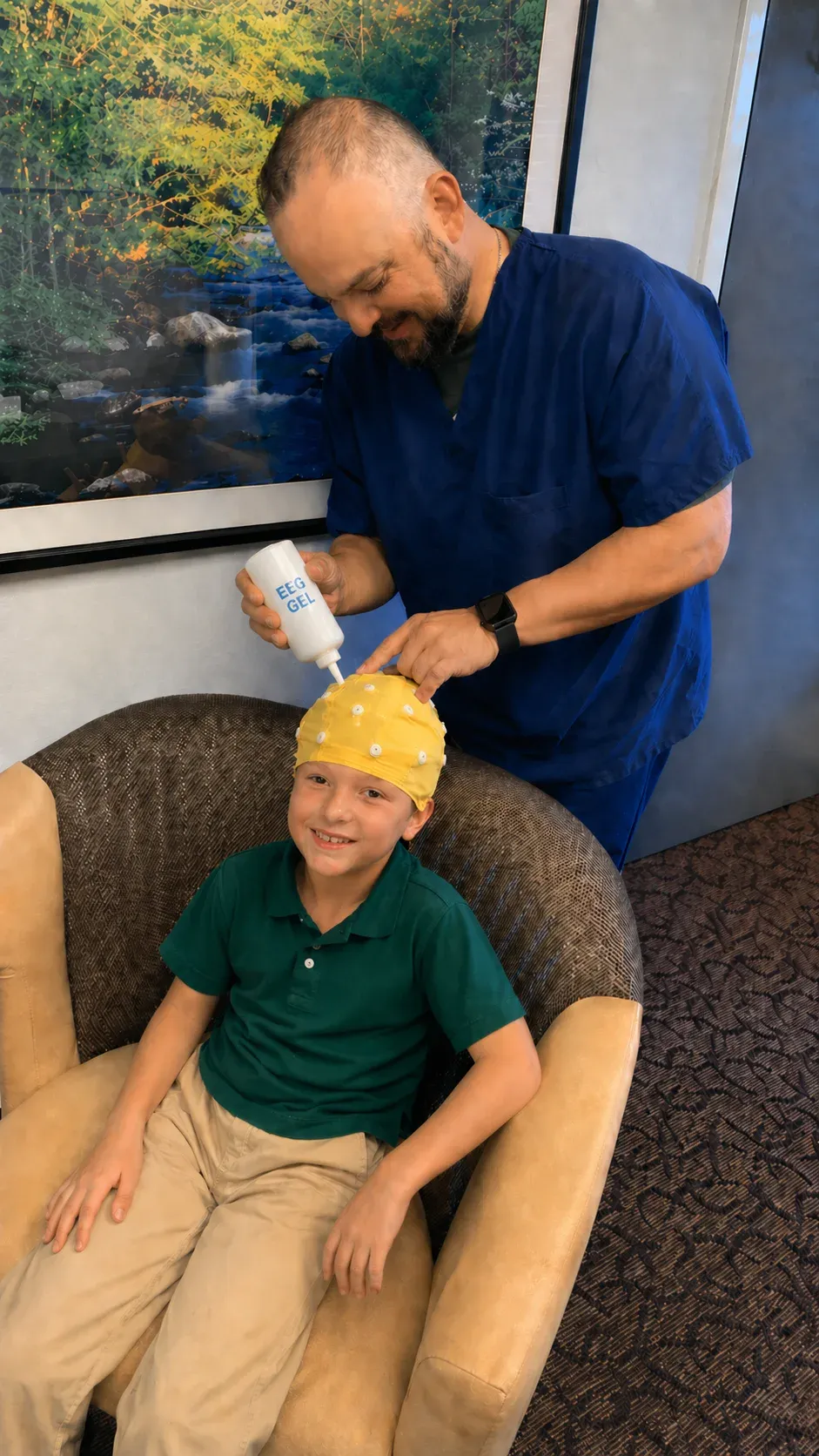
A soft cap goes on
It looks like a swim cap with 19 small sensors built in. We adjust it until it’s comfortable.
- 2
A little gel at each sensor
A conductive gel helps each sensor read clearly. No needles — the applicator has a blunt tip and only touches the cap.
- 3
Two small ear clips
Light clips on the earlobes give the recording a reference point.
- 4
Sit quietly for a few minutes
Eyes closed, then eyes open — under 10 minutes of recording in total, while your brainwaves appear live on screen.
What you take home
Your brain map, on paper — and explained in plain English.
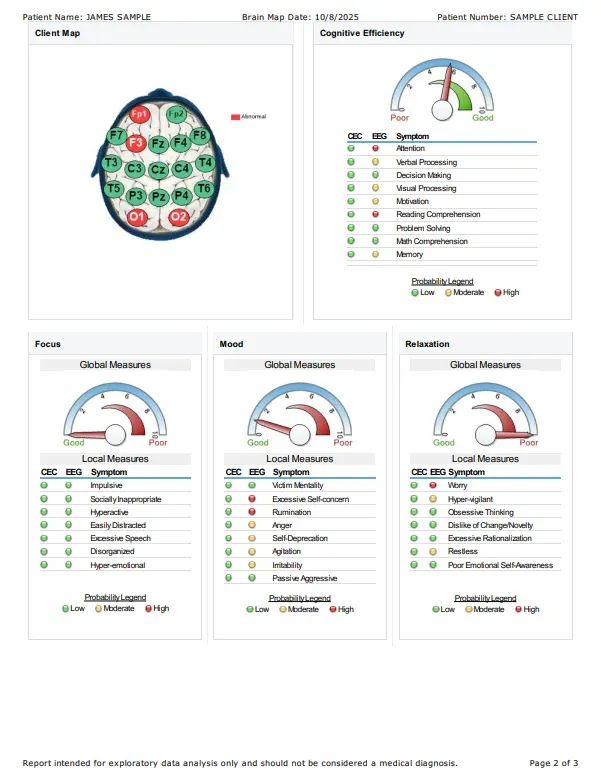
At your Report of Findings we walk through every page together. Here’s what one of them shows.
The head map
Nineteen sensor sites, each colored by whether your activity there sits in the typical range or outside it.
Cognitive efficiency
A single gauge for how efficiently the brain is working, with the everyday skills it feeds: attention, memory, processing, problem-solving.
Focus, mood and relaxation
Three gauges, each tied to real-world signs like distractibility, rumination or restlessness — so the numbers connect to what you actually see.
What it is not
Not a diagnosis, and not an MRI. It’s a measurement of regulation that tells us where to train — and lets us measure change later.
“Before neurofeedback our son was moody, short-tempered, isolating himself and anxious. He was joyful and silly again, sought out social interactions, and his impulsivity and anxieties decreased. Thank you Adrian and the Kerov team for giving us our kid back.”
Clinical expertise
28 years of clinical practice. A new level of clarity.
Certified in qEEG and neurofeedback since 2002, Adrian combines deep clinical insight with objective data to help adults and children calm an over-aroused nervous system. We believe people living with anxiety deserve more than a prescription pad and a coping-skills handout — they deserve a clear picture of what’s happening in their brain, and a plan that fits.
- 28+
- years in clinical practice
- 2002
- certified in qEEG & neurofeedback
Adrian E. Quevedo, MS, NEI
Co-Founder & Clinical Director
The process
Four steps. One office visit. Training at home.
- 01
Free consult
Tell us what’s going on. We’ll explain how the program works and whether it’s a fit — no pressure, no cost.
- 02
Brain map (qEEG)
A comfortable sensor cap records your brain’s electrical activity — in our office, or with a cap we ship to you. Painless, and under 10 minutes of recording.
- 03
Report of Findings
We walk you through your map in plain English and lay out a personalized plan, timeline and cost.
- 04
Train at home
Pick up your kit and train on your schedule while watching shows you like. We monitor progress and meet weekly on Zoom.
Good questions
Anxiety & neurofeedback, answered.
What is neurofeedback?
Neurofeedback is a form of biofeedback for the brain. Small sensors on the scalp read your brainwaves (EEG) while you watch a show. When your brain moves toward a calmer, more focused pattern, the screen brightens; when it drifts, the screen dims. Over many sessions the brain learns to find that balanced state on its own. Nothing is put into the brain — the sensors only listen.
Can neurofeedback really be done at home?
Yes. After your in-office brain map, all training happens at home with a clinic-grade kit we configure for you. We monitor your data remotely, adjust your protocols, and meet with you weekly on Zoom — so you get clinical supervision without the weekly commute.
How soon will I notice changes?
Everyone responds differently. Many clients first report better sleep, often within the first 10 sessions, followed by improvements in focus and mood. We track your data weekly so progress isn’t a guessing game.
Do the results last?
Neurofeedback is a learning process, and like other learned skills the gains tend to hold. Life doesn’t stay still, though — a new job, a loss, a hard school year, an illness or a head injury can all shift things. That’s why many clients keep a maintenance option: a short tune-up when they need it, on their own schedule. It’s a choice, not a dependency.
Do I need to stop medication?
No — and never change or stop a medication without your prescribing doctor. Neurofeedback can be done alongside medication. If your needs change over time, that’s a conversation between you and your doctor.
What does it cost? Do you take insurance?
We don’t bill insurance. We accept HSA/FSA funds and offer financing through the Advance Care Card — interest-free for up to 15 months, with instant online decisions — so the program can be spread into monthly payments. You’ll see the complete cost at your Report of Findings, before you commit to anything. The first consult is free.How to apply →
Neurofeedback supports self-regulation; it does not diagnose, treat or cure anxiety disorders or PTSD. If you are in crisis, call or text 988 (veterans: press 1). Never change a medication without your prescribing doctor.
Your next step
Ready to find out why your brain won’t settle?
Pick a time that works for you. We’ll listen, answer your questions, and tell you honestly whether our program is a fit.
- 30 minutes · Zoom or phone · no obligation
- Talk with a clinician, not a salesperson
- Leave with a clear picture of the process and cost
Prefer to talk now? (407) 708-3200