
Your child
Help your child find focus, calm and confidence.
You’ve tried the charts, the tutors, maybe the medications. A brain map shows why your child is struggling — and at-home neurofeedback gives their brain a way to practice focus and calm. No pills. No weekly drive.
What brings families to us
It’s not about trying harder. It’s about how their brain is regulating.

ADHD & focus
Trouble starting, staying on, or finishing tasks. Homework battles. “Bright, but not working to potential.”
Big emotions
Meltdowns, irritability, and a hard time calming down once upset.
Anxiety & worry
Stomach aches before school, perfectionism, trouble separating or sleeping alone.
Autism spectrum support
Families often come to us for help with regulation, sleep and attention alongside their child’s existing therapies.
School performance
Studying, test-taking, retention and the confidence that comes with them.
Neurofeedback is a training tool that supports self-regulation. It does not diagnose, treat or cure any condition, and works alongside — not instead of — your child’s medical and therapeutic care.
What it’s like for kids
To them, it’s screen time. To their brain, it’s practice.
Your child watches a favorite show with a few small sensors on their head. When their brain settles into a focused, calm pattern, the picture stays bright. When it drifts, the screen dims — and their brain learns, on its own, how to bring it back.
Sessions are 20–30 minutes, five to seven times a week, at home. We set everything up, teach you how to run it, watch the data remotely and meet with you every week.
The brain map
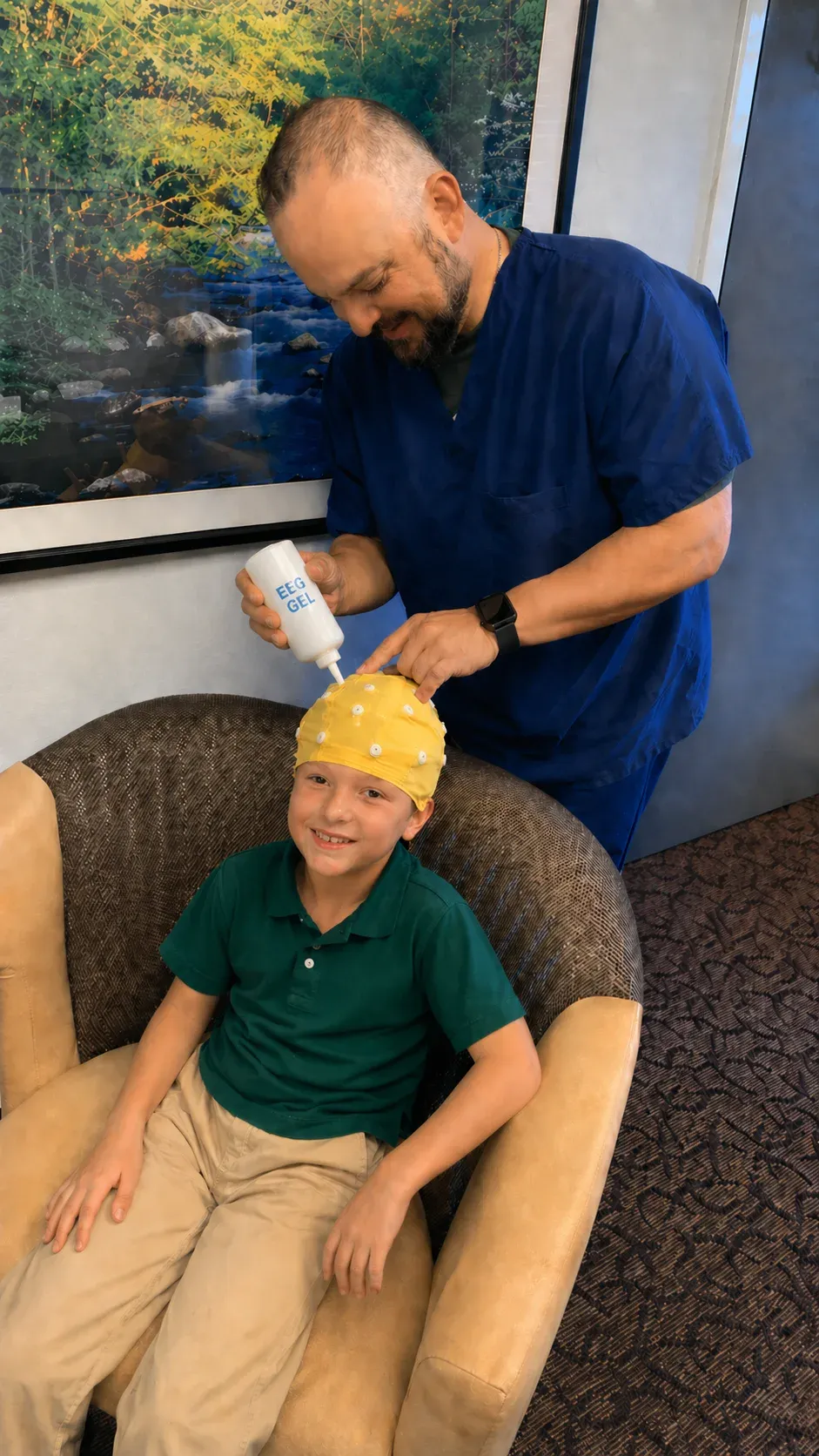
The one office visit — and kids usually think the cap is fun.
Before any training, we take a qEEG brain map so your child’s plan is built on data. It only listens to the brain’s natural activity — nothing is sent in, and nothing hurts.
- 1
A soft cap goes on
It looks like a swim cap with 19 small sensors built in. We adjust it until it’s comfortable.
- 2
A little gel at each sensor
A conductive gel helps each sensor read clearly. No needles — the applicator has a blunt tip and only touches the cap.
- 3
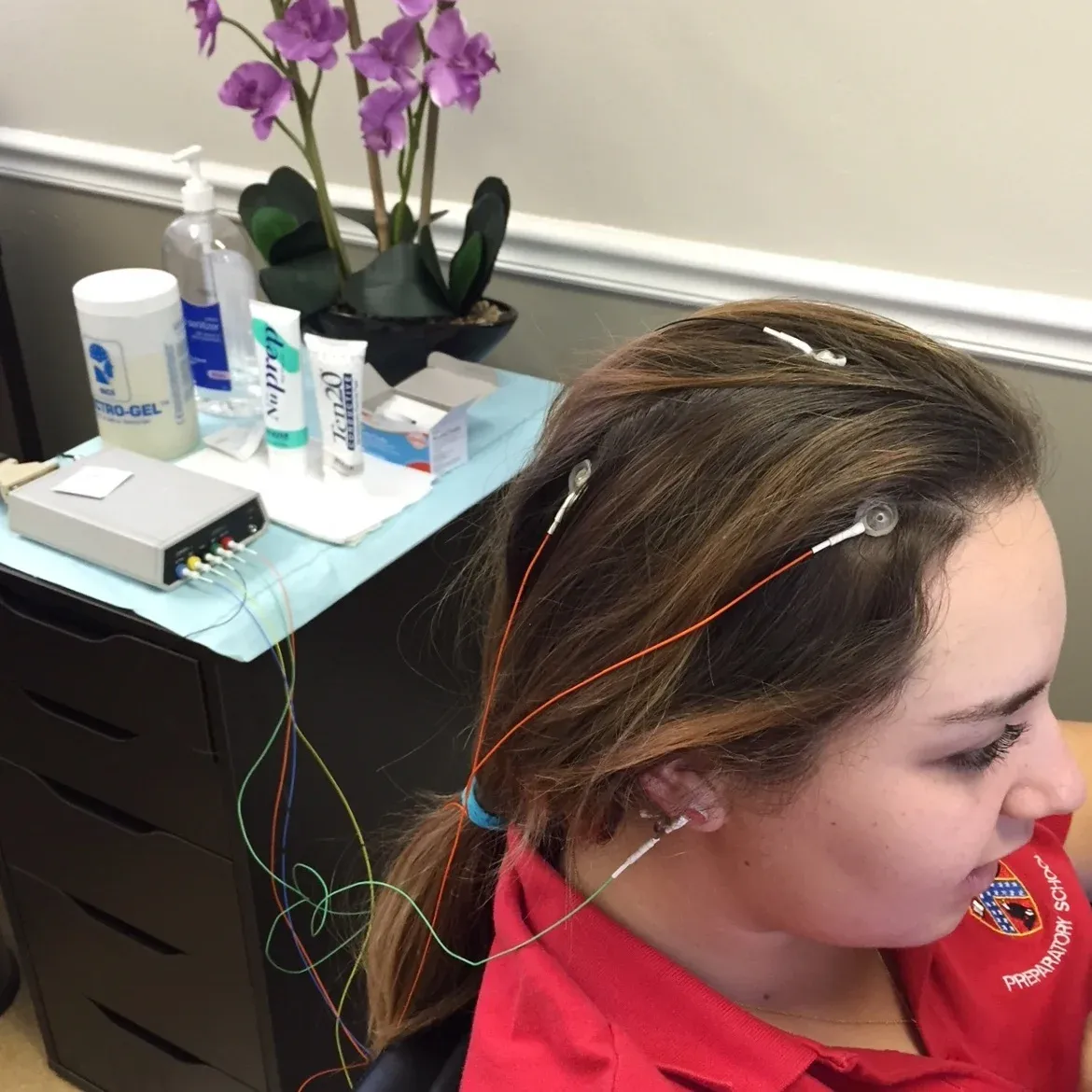
Two small ear clips
Light clips on the earlobes give the recording a reference point.
- 4
Sit quietly for a few minutes
Eyes closed first, then eyes open — and if a younger child can’t keep their eyes closed, eyes open is all we need. Under 10 minutes of recording in total, while the brainwaves appear live on screen.
What you take home
Your brain map, on paper — and explained in plain English.
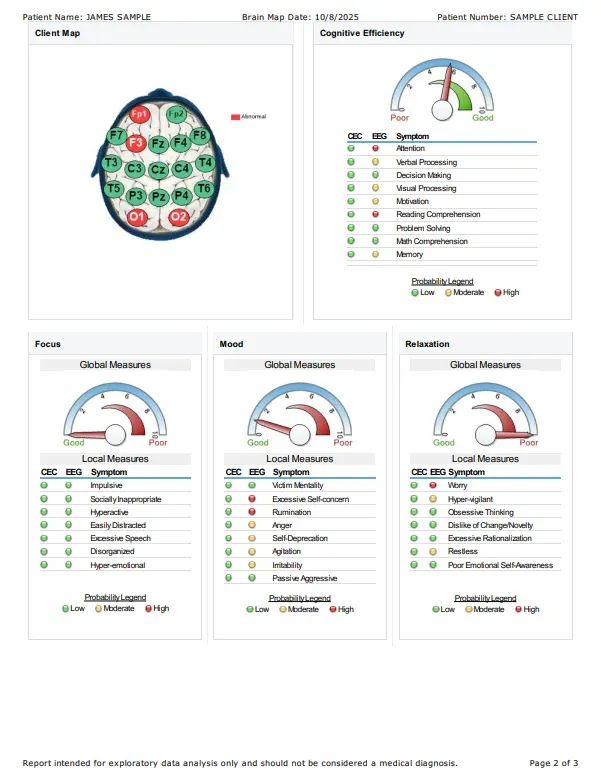
At your Report of Findings we walk through every page together. Here’s what one of them shows.
The head map
Nineteen sensor sites, each colored by whether your child’s activity there sits in the typical range or outside it.
Cognitive efficiency
A single gauge for how efficiently the brain is working, with the everyday skills it feeds: attention, memory, processing, problem-solving.
Focus, mood and relaxation
Three gauges, each tied to real-world signs like distractibility, rumination or restlessness — so the numbers connect to what you actually see.
What it is not
Not a diagnosis, and not an MRI. It’s a measurement of regulation that tells us where to train — and lets us measure change later.

What parents tell us they notice
Small changes at home are usually the first sign.
- Homework takes less time — and fewer reminders
- Fewer meltdowns, faster recovery after them
- Falling asleep more easily
- Calmer mornings and transitions
- More confidence at school and with friends
- A child who seems more “like themselves”
Every child responds differently; results are not guaranteed.
The process
Four steps. One office visit.
- 01
Free consult
Tell us what’s going on. We’ll explain how the program works and whether it’s a fit — no pressure, no cost.
- 02
Brain map (qEEG)
A comfortable sensor cap records your brain’s electrical activity — in our office, or with a cap we ship to you. Painless, and under 10 minutes of recording.
- 03
Report of Findings
We walk you through your map in plain English and lay out a personalized plan, timeline and cost.
- 04
Train at home
Pick up your kit and train on your schedule while watching shows you like. We monitor progress and meet weekly on Zoom.
Parents ask
Questions about kids & neurofeedback.
What is neurofeedback?
Neurofeedback is a form of biofeedback for the brain. Small sensors on the scalp read your brainwaves (EEG) while you watch a show. When your brain moves toward a calmer, more focused pattern, the screen brightens; when it drifts, the screen dims. Over many sessions the brain learns to find that balanced state on its own. Nothing is put into the brain — the sensors only listen.
Can neurofeedback really be done at home?
Yes. After your in-office brain map, all training happens at home with a clinic-grade kit we configure for you. We monitor your data remotely, adjust your protocols, and meet with you weekly on Zoom — so you get clinical supervision without the weekly commute.
How soon will I notice changes?
Everyone responds differently. Many clients first report better sleep, often within the first 10 sessions, followed by improvements in focus and mood. We track your data weekly so progress isn’t a guessing game.
Is there a maintenance program?
Yes. After the Foundation Phase, you can keep your system for maintenance — a short tune-up whenever life calls for one. Think of it like the skill itself: a child who trained for focus in elementary school can use the same skill years later for the social stress of high school, without turning to medication. Maintenance is optional and on your schedule; it is never a requirement.
Is it safe for children?
Yes. Neurofeedback is non-invasive and drug-free, and we work with children as young as four. Sessions feel like watching a show. Some people feel a little tired after early sessions; this typically fades within the first couple of weeks.
Do I need to stop medication?
No — and never change or stop a medication without your prescribing doctor. Neurofeedback can be done alongside medication. If your needs change over time, that’s a conversation between you and your doctor.
What if we miss a session?
Life happens. Missing an occasional session won’t erase progress — consistency over weeks is what matters, and we’ll help you build a routine that fits your household.
Your next step
Let’s talk about your child.
Book a free 30-minute consult. Tell us what you’re seeing at home and at school, and we’ll tell you honestly whether we can help.
- 30 minutes · Zoom or phone · no obligation
- Talk with a clinician, not a salesperson
- Leave with a clear picture of the process and cost
Prefer to talk now? (407) 708-3200